Most Spoken Language in America: English, Spanish and the Data
English is the most spoken language in the US and Spanish comes second. See what the Census and other sources report, and what it means for site languages.
English is the most common language spoken at home in the United States, according to the Census Bureau's 2019 report. More recent estimates point the same way: VMEG's summary of ACS 2024 puts English-only speakers at home at roughly 77% of people aged 5 and over. Spanish is the most common language other than English spoken at home, with 44.9 million speakers in 2024, although counts vary by source and year.
- English is the majority language: VMEG reports English-only speakers at home at about 247.7 million, roughly 77% of people aged 5 and over.
- Spanish is the largest non-English home language, at 61.1% of non-English home languages in the 2018–2022 ACS 5-year release, as summarized by VMEG.
- Rankings below the top two are not firm: the Census Bureau warns that some differences between ranks may not be statistically significant.
- Choose additional website languages from audience data for your region and product.
Which language is most spoken in the United States?
English is the most common language spoken at home, according to the Census Bureau's 2019 report. That is the most recent report of its type among the sources used here, so the figure is dated and should be quoted with its year.
VMEG summarizes ACS 2024 estimates that put English-only speakers at home at about 247.7 million, roughly 77% of the population aged 5 and over.
What does "most spoken" actually measure?
The usual measure is the language spoken at home, which is what the Census Bureau's language tables count. Axios points out that many multilingual people speak one language at home with family but use English at work, school and elsewhere. A home-language count therefore says little about the English many of them use outside the house.
That gap matters for websites: a home-language figure does not tell you which language a visitor prefers when reading online.
How many people speak Spanish, and why do the numbers differ?
Spanish is the most common language other than English spoken at home. Visual Capitalist reports 44.9 million speakers in 2024, up from 11.1 million in 1980. Axios cites a lower figure of about 41.2 million for 2017–2021, counting people aged 5 and over. Spanish counts vary by dataset and year, so always cite the source and period.
| Source | Period | Measure | Figure |
|---|---|---|---|
| Visual Capitalist | 2024 | Spanish speakers at home | 44.9 million |
| Axios | 2017–2021 | Spanish speakers, aged 5 and over | About 41.2 million |
| Census Bureau ACS 5-year release, via VMEG | 2018–2022 | Share of non-English home languages | 61.1% |
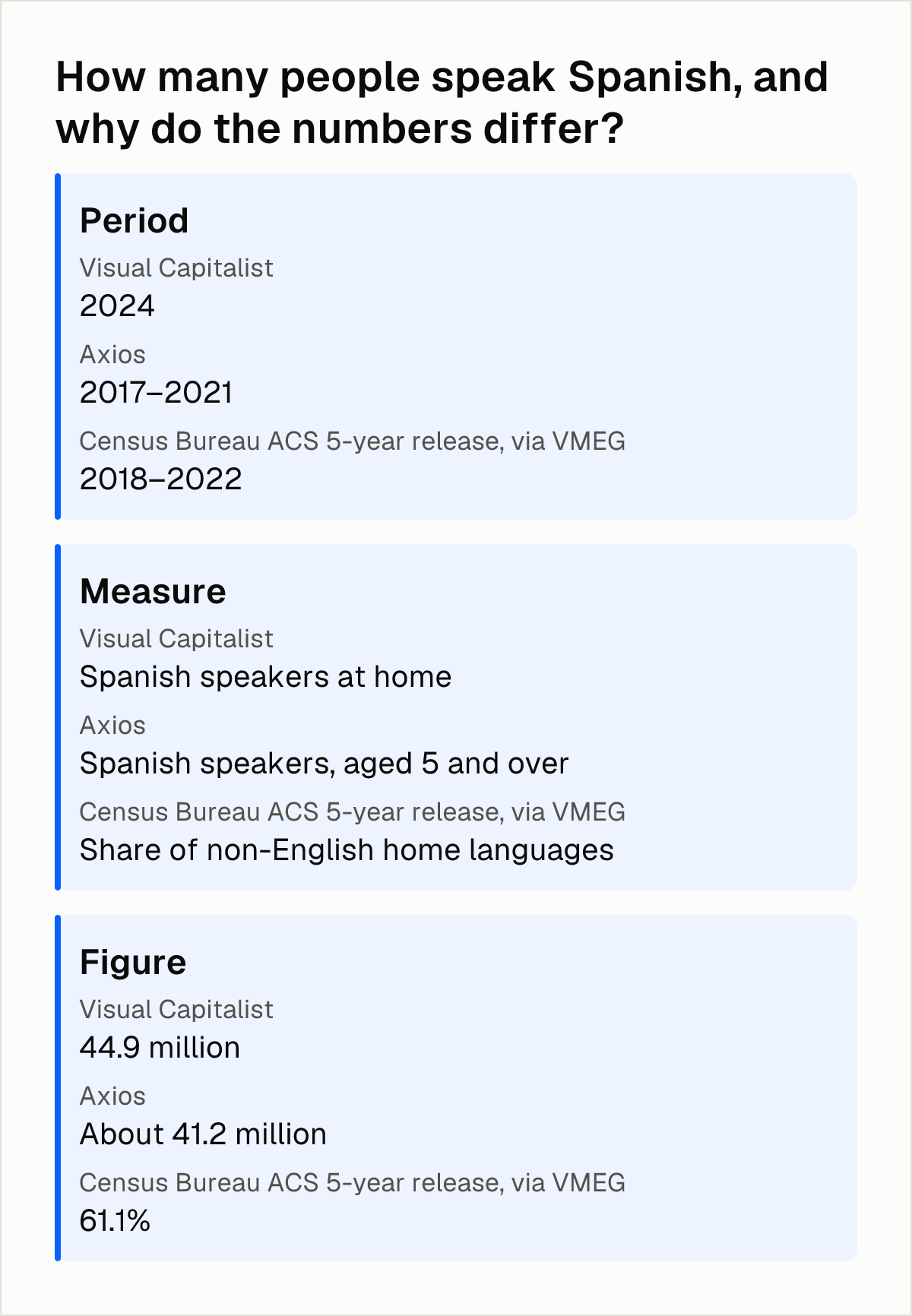
VMEG reports that in that 5-year release Spanish accounted for 61.1% of non-English home languages, ahead of Chinese at 5.1%. Share-of-population figures also vary by source: one guide gives 13.6% of Americans aged 5 and older speaking Spanish at home, while another source gives 13.2%, citing the ACS. When you publish a percentage, take it from the Census Bureau's own table and name the year.
How well do non-English home speakers speak English?
In the 2017–2021 period, 22% of people aged 5 and over spoke a language other than English at home, according to the Census Bureau's language release. The same release reports:
"Sixty-two percent of those who spoke a language other than English at home also spoke English 'very well.'" — Census Bureau, 2017–2021 ACS language use tables
Whether a site needs a second language depends on its audience, not only on the national ranking.
Which languages come after English and Spanish?
Chinese, Tagalog and Vietnamese are the next most common languages. Census survey data for 2017–2021 gives Chinese about 3.5 million speakers and Tagalog about 1.7 million, according to Axios. The order shifts by source: Visual Capitalist ranks Chinese second and Tagalog fourth among non-English home languages in 2024, while the 2017–2021 Census ranking has Vietnamese third.
The Census Bureau's release says that differences between ranks may not be significant at the 90 percent confidence level. Treat exact positions below the top two as approximate. The same release notes that the detailed tables cover over 500 individual languages and language groups, so any top-10 list shows only a small slice of the country's language use.
What if "America" means the whole continent?
Questions about America sometimes mean the wider continent. The Wikipedia page on North America states that English is the most widely spoken language in North America, followed by Spanish and then French. That page carries a note saying it needs additional citations. Figures for the whole of the Americas depend on how "native speaker" and "America" are defined. For a US answer, use Census data and keep it separate from continental numbers.
What does this mean for a US-market website?
The national data supports a clear order: English first, then Spanish, which leads the non-English home languages by a wide margin. Beyond Spanish, choose languages from audience data for your region and product, because rankings below the top two are not firm enough to set priorities on their own.
Adding languages is also a cost decision. Translate first into the languages your audience uses, then measure whether visitors use those versions before expanding. If you work with Webflow, Lantis has a breakdown of how Webflow translation tools bill, and a comparison of five AI translation tools looks at translation quality. Other tools may suit your stack or budget better, so compare several on the same criteria.
Next steps
- Open the Census Bureau's S1601 table for the state or metro area you sell in, and note which home languages appear after English and Spanish.
- Write the year and the table name next to every language figure you publish, and avoid mixing percentages from different periods.
- Check your own analytics for the browser languages of your visitors, and compare them with the Census data before choosing languages.
- Add one language at a time and review traffic and conversions in that language before adding more.
- For site-translation setup, Lantis publishes a guide to translating a Framer site.
Frequently asked questions
What is the second most spoken language in the United States?
Spanish. It is the most common language other than English spoken at home, with 44.9 million speakers in 2024 according to Visual Capitalist. VMEG reports that Spanish accounted for 61.1% of non-English home languages in the 2018–2022 ACS 5-year release.
How many people speak Spanish in the United States?
It depends on the dataset and year. Visual Capitalist reports 44.9 million Spanish speakers at home in 2024, while Axios cites about 41.2 million for 2017–2021. Always state the period when you quote a number.
Is Spanish spoken more than English in America?
No, not in the United States. English is the most common home language: about 247.7 million people, or roughly 77% of those aged 5 and over, speak only English at home, according to ACS 2024 estimates summarized by VMEG. Spanish has far fewer home speakers, at 44.9 million in 2024 per Visual Capitalist.
Which languages are most common after English and Spanish in the United States?
Chinese, Tagalog and Vietnamese. Axios reports about 3.5 million Chinese speakers and 1.7 million Tagalog speakers for 2017–2021. Their exact order differs between sources, and the Census Bureau cautions that differences between ranks may not be statistically significant.
Sources
- American Community Survey Reports: Language Use in the United States: 2019
- Most Spoken Languages in the US (2026 Data Guide), VMEG
- America's Most-Spoken Languages Besides English (1980-2024), Visual Capitalist
- The most popular U.S. languages besides English and Spanish, Axios
- Most Spoken Languages in the United States: A Real Guide, Talk and Chalk
- graphsearch.epfl.ch, language concept page
- Census Bureau press release, 2017–2021 ACS language use tables
- S1601: Language Spoken at Home, Census Bureau
- Languages of North America, Wikipedia
Pon tu web en varios idiomas hoy.
Una línea de código. SEO real por idioma. Traducción con IA. Sin tarjeta para empezar.