How to Count a Web Page's Words and What Length It Needs
Google has no preferred word count, so no page needs a fixed length. Learn how to count a page's words, why tools differ, and how to estimate translation…
Google says it has no preferred word count for content, so no page has to reach a fixed length, according to Grounded Kit's verified claim. A page's word count is the total of its words, including headings, body text and lists, but the figure shifts with the counting tool, and navigation, footers and JavaScript-rendered text can change it a lot. For translated sites, some providers base the billable figure on the words in the target-language version.
Lo esencial
- Measure each page the same way every time: body text only, one tool, and a recorded date.
- Treat length benchmarks as context. Studies disagree on averages, and none shows that a fixed length ranks better.
- Count metadata separately (meta titles, meta descriptions, alt text), because translation providers may bill for it.
- For translation budgets, estimate target-language words per page, then compare the result with your tool's pricing model.
What does "web page word count" actually ask?
Most people searching this phrase want two things: a reliable number for one page, and a sense of how long that page should be. The first is a measurement problem. The second has no official answer, since Google publishes no target length for a page.
Start with the measurement, then treat any length benchmark as context rather than a rule.
What counts as a word on a page?
Yoast defines word count broadly: the total number of words on a page, including headings, body text and lists.
Some words are invisible. Weglot counts both visible and invisible content for website translation, including meta titles, meta descriptions and image alt attributes.
Which number you need depends on the question. For editorial length, body copy matters most. For translation volume, SEO metadata may be part of the billable text. Keep two figures: visible body text for content planning, and everything translatable for cost estimates.
Why does the same page give different counts?
Page furniture inflates the total. According to Crawlraven's page counter, navigation, headers and footers add to a raw count, so a site-wide block of text lands in every page's total: a 400-word footer adds 400 words to every page.
Counting tools also disagree. Wikipedia's entry on word count notes that different programs can return different totals because they apply different text segmentation rules. Compare results only within the same tool.
JavaScript pages are a special case. Crawlraven notes that on a client-rendered page, the count from server HTML and the count of rendered text can differ by thousands of words. Check both the raw HTML and the rendered page before drawing conclusions.
A practical method: copy only the main content, excluding navigation, headers, footers and sidebars, run it through one tool, and record the tool name and date so the count can be repeated.
How long should a page be? What the benchmarks show
Benchmarks describe patterns, not requirements. Backlinko's analysis of 11.8 million Google results puts the average first-page result at 1,447 words, and the same study found no direct relationship between word count and rankings.
Other figures conflict with it. A 2025 Ranktracker guide cites a different Backlinko figure: 1,890 words for top-ranking pages, up from 1,480 in 2019. Averages from different studies do not agree, so none can serve as a single target.
Ahrefs figures appear in a statistics roundup: an average of 1,188 words for current Google organic results, measured on text with HTML and boilerplate stripped, across 174,048 pages in December 2025. The same roundup reports only a 0.04 correlation between content length and AI Overview citations, a weak link.
For new domains, a SEMrush study found that top performers averaged 846 words, against 243 words for all qualifying sites.
A page should be as long as its question needs. Length follows from covering a topic fully; it is not a goal in itself.
Do SEO tools set minimum word counts?
Some do. Yoast's plugin advises more than 300 words for a standard post or page and more than 900 for a cornerstone page, and flags pages below that with a red light.
These are plugin rules and not Google's. Since Google has no preferred word count, a 300-word service page can be complete if it answers the question it targets.
Use the thresholds as a prompt to check whether a page is missing an explanation, a comparison or an example. They work as a checklist rather than a pass-or-fail test.
How does word count affect translation cost?
For a multilingual site, translation volume is the number that matters, and it does not always match the source count. A translator's 2013 post says Romance languages use about 30% more words than English for the same idea, so expansion varies by language.
Some quotes use the target text. RushTranslate's help center explains that its final billable count is usually based on the target translation, which can be higher or lower depending on language expansion or contraction.
Before comparing quotes, ask:
- Does the price use source words or target words?
- Does it include metadata and alt text?
- Does it cover every language, or only some?
Pricing models differ between providers, so apply those same questions to each one. Lantis bills per active language: 3 € per month for one language, 2,50 € per language per month for 2 to 9 languages, and 2 € per language per month for 10 or more. Each language includes 500.000 words, and extra blocks of 500.000 words cost 1 € as a one-time payment. Lantis works on Framer, Webflow, Shopify, WordPress and any website, with no limit on sites or visitors. A per-language plan suits sites that translate into several languages; a very small site with a single language and few words may find another model, such as a per-word quote from a translation provider, just as workable. For a comparison of how Webflow translation tools bill, see how each Webflow tool bills.
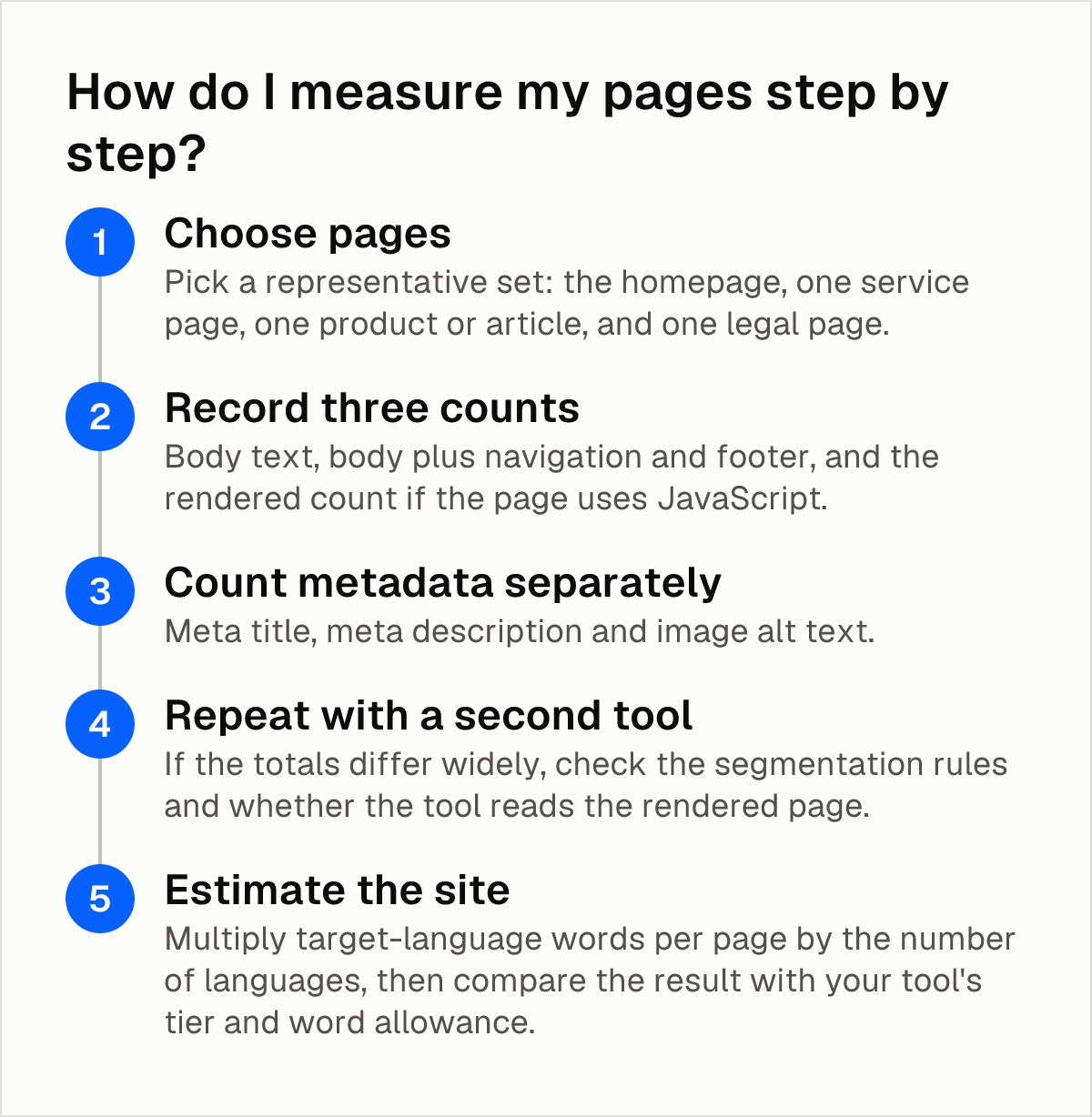
How do I measure my pages step by step?
- Choose pages: pick a representative set: the homepage, one service page, one product or article, and one legal page.
- Record three counts: body text, body plus navigation and footer, and the rendered count if the page uses JavaScript.
- Count metadata separately: meta title, meta description and image alt text. Note which ones you plan to translate.
- Repeat with a second tool: if the totals differ widely, check the segmentation rules and whether the tool reads the rendered page.
- Estimate the site: multiply target-language words per page by the number of languages, then compare the result with your tool's tier and word allowance.
For metadata specifics, read the guide on translating titles and meta descriptions. For Shopify catalogs, the multilingual Shopify SEO guide is further reading.
Next steps
- Pick five representative pages and record their body word count with one tool, noting the tool name and date.
- Run each JavaScript-heavy page twice, once on the raw HTML and once on the rendered text, and note the gap.
- List the metadata you would translate (meta titles, meta descriptions, alt text) and count those words separately.
- Ask each translation provider whether it bills on source or target words, and whether metadata is included.
- If you use Framer, Lantis has a guide comparing Framer translation options.
Frequently asked questions
Does word count include navigation and footer text?
A raw count does, which is why a 400-word footer adds 400 words to every page, as Crawlraven notes. For content planning, count only the main body. For translation, check whether the provider bills repeated site-wide text.
How do I count words on a page that loads with JavaScript?
Count both the server HTML and the rendered text. Crawlraven reports that on client-rendered pages the two figures can differ by thousands of words. Use the rendered count for what visitors read.
Do translated SEO meta titles and alt text count toward word limits?
It depends on the provider. Weglot's word count includes SEO metadata such as meta titles, descriptions and image alt attributes. Ask any provider whether metadata is billed and count it separately.
Is 300 words enough for a service page?
Google has no preferred word count, so length alone does not decide it. Yoast's plugin advises more than 300 words for a standard page, but that is a plugin guideline. The page is enough if it fully answers the question it targets.
Sources
- Grounded Kit: Google has no preferred word count
- Yoast: Word count and SEO
- Weglot Academy: Understanding word count
- Crawlraven: Free Page Word Counter
- Wikipedia: Word count
- Backlinko: 11.8 million Google search results
- Ranktracker: Content Length Statistics 2025
- Milan Novotny: Short-Form vs Long-Form Content Statistics
- SEMrush: How Long Does It Take to Rank
- Training for Translators: Thoughts on word counts
- RushTranslate: How Translation Word and Page Counts Work
Pon tu web en varios idiomas hoy.
Una línea de código. SEO real por idioma. Traducción con IA. Sin tarjeta para empezar.